A VP responsible for frontline operations believed something was wrong long before he could prove it. His people were stretched thin: short-staffed, working under budget pressure, in an environment where the work itself was demanding and the margin for error was low. An engagement survey had hinted at it. He wanted proof before deciding what action to take.
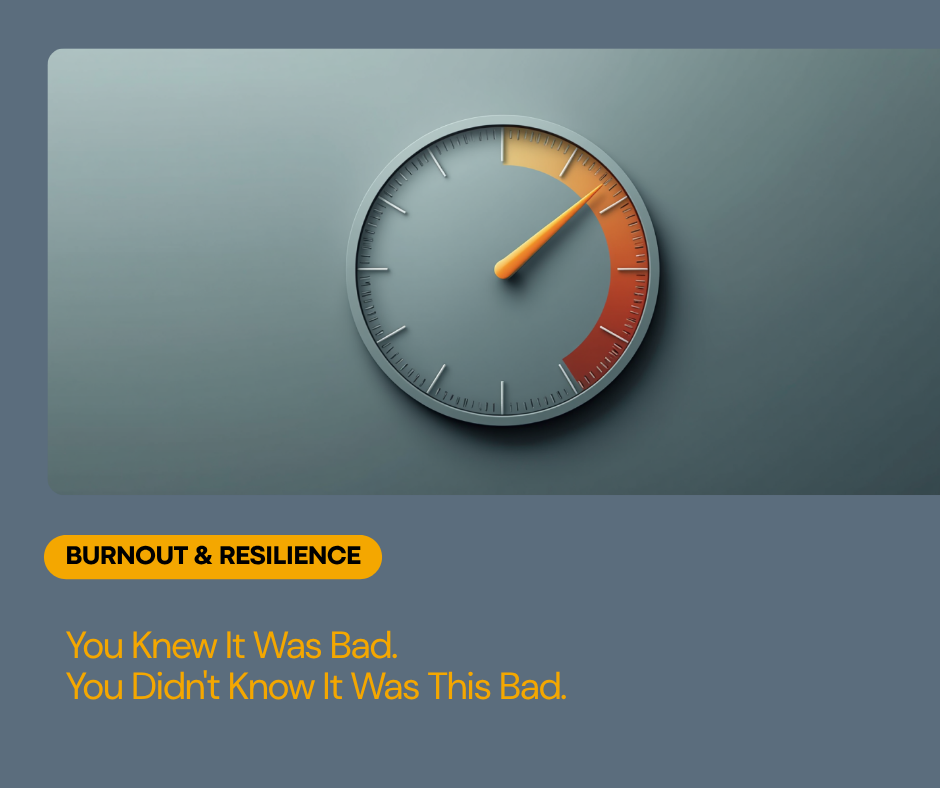
So, he brought in a way to measure it. When the results came back, they were worse than the engagement survey had suggested and worse than he’d let himself believe. “We knew it was bad,” he said. “We didn’t know it was this bad.”
That’s where most leaders stop: with a worse number than they expected, and a decision to live with it. He didn’t. He went looking for the right support, found a program built specifically for this kind of chronic stress, and made the decision to fund and run it, in a system where every dollar and every hour off the floor was already contested. Recognizing the problem was diagnosis. Going out on a limb to fund and execute the fix was leadership.
The same pattern showed up in a different organization entirely. A leader recently promoted to partner, still one of relatively few women to reach that level in her firm, was carrying a quieter version of the same exhaustion. Nobody told her to work 10- to 12-hour days. She told herself to. The pressure to prove she belonged in the role was partly the firm’s and partly her own, and by the time we talked she could no longer fully separate the two. The exhaustion wasn’t just fatigue anymore. It was physical. It was emotional. Pushing through had been her strategy up to that point because pushing through had always worked before. Until it didn’t.
Her work wasn’t learning to endure the pressure better. It was helping her see which parts of it were real and which parts she was generating herself, and then using the authority that came with her new position instead of working around it. That meant setting boundaries she’d been treating as optional, delegating work she’d been holding onto as proof of her value, and learning that saying no to some of it was not the same as failing to earn the seat. Establishing that authority, not absorbing more, was what actually changed her trajectory.
Both leaders had been reading exhaustion as effort: his team’s as dedication, hers as overextension, right up until something outside their own judgment said otherwise. And both stories resolved the same way: the turning point wasn’t the measurement. It was what each of them did with it. He used the data to make a hard, exposed funding decision. She used the insight to claim authority she already had and had been declining to use. Measurement without that follow-through is just a worse number to be anxious about. That follow-through (turning what the data shows into a decision, a boundary, or a funding request someone is willing to put their name on) is the actual coaching work. Everything else is just data collection.
Burnout gets misread because the word itself has gone soft with overuse. It isn’t a personal collapse or a character weakness: it’s a chronic stress syndrome, a response to a workplace environment that’s been overwhelming or corrosive for too long without relief. That distinction relocates the issue: understaffing, ambiguous workload, unexamined ideas about what “committed” looks like, and a culture that rewards endurance over sustainability will produce this syndrome as reliably as an under-resourced plan produces a missed deadline. The organization rarely sees it until something forces the look: a survey, a real measurement, a resignation nobody saw coming.
Resilience, in that light, isn’t grit. Grit is what both leaders already had in abundance. It’s what let them push as long as they did. Resilience is the capacity to recover, sustainably, under conditions that keep recurring. You cannot will that into existence through effort. It has to be built into how work gets designed, staffed, and led, which makes it a leadership responsibility, not a personal resource employees are expected to supply on their own.
Neither of these stories ends with an inspirational turnaround. They end with two leaders who looked honestly at something most people would rather not see, and then did something uncomfortable with it: one funded a fix he couldn’t be certain would work, the other started exercising authority she’d been leaving on the table. That’s harder than the diagnosis, because it requires admitting that pushing through was never actually working.
“If you looked honestly at your team’s exhaustion tomorrow, would it confirm what you already suspect — or would it be worse?”