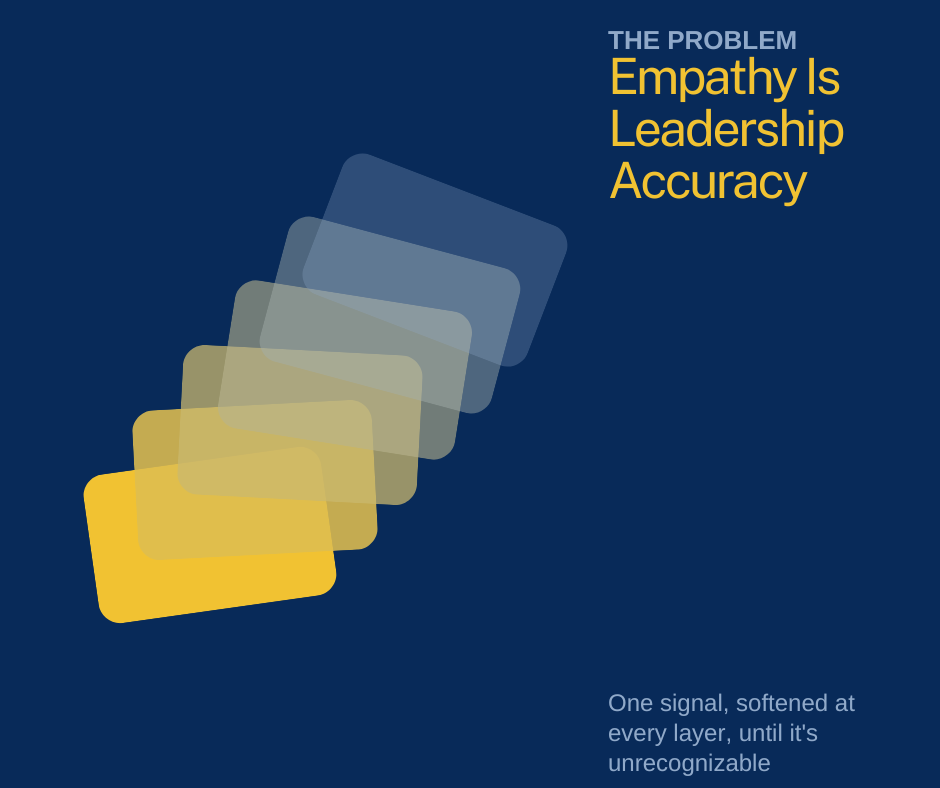
Empathy is not the soft skill people think it is. It is the discipline that gets a leader the truth in time to act on it.
Early in my career, I worked as chief of staff to the president of a large sales division within a Fortune 500 company. He had a rule he repeated often: “We’re a sales organization. People love bringing good news forward. But you can’t fix good news. All you can say is ‘good job.’ Our job is to go find the bad news and fix what’s broken.”
It reframed the job for me. Most leaders assume their biggest information problem is volume — too much coming at them, not enough time to process it. His problem was the opposite. Not enough of what reached him was actionable.
Bad news doesn’t travel up an organization on its own. People protect themselves. They don’t want to look responsible for a problem, they don’t want to be the one who raises it, and they’ve usually learned that raising it rarely changes anything except how they’re seen. So, the org chart works exactly as designed: filtering out precisely the information a leader needs most.
He solved for this deliberately, not sentimentally. He spent most of his time on the road, in client meetings and sales offices, asking one question relentlessly: what would make this easier, or make it easier to serve the client? Closer to home, he ran an unusual ritual. He held season tickets to a local professional baseball team — great seats, a hot ticket, the kind nobody turned down. For many home games, one of my tasks was to find nine people across the division who had never met him — an administrator, an engineer, an accountant, a salesperson — and get them the tickets. Somewhere between the hot dogs and the seventh inning, sitting next to the division president instead of across a desk from him, people said what they would never put in a memo.
We debriefed the next morning, and he told me what he’d heard. Sometimes the fix was complex. Sometimes it was fairly straightforward — a piece of the sales compensation plan quietly incenting the wrong behavior. Either way, I went and figured out how to get it fixed. Always without attribution. He was protecting the channel, not collecting credit.
What he was building, in today’s language, is psychological safety — the belief that raising a hard truth wouldn’t be held against you. He never used the term. He enforced it instead: no attribution, no blame, no surprise the next time you saw him.
That is empathy doing the work of intelligence-gathering, not sentiment. He wasn’t trying to make people feel good. He was building a mechanism that let the truth reach him before it calcified into a bigger problem. The warmth was real, but it was in service of accuracy — his read on the organization was more accurate because he had built a system that surfaced what the formal chain filtered out.
Here’s the distinction worth making. Empathy gets mistaken for softness because, from the outside, it looks like kindness for its own sake. It isn’t. Alfred Adler defined it precisely: empathy is seeing with the eyes of another, listening with the ears of another, feeling with the heart of another. Do that well and you don’t just understand people better. You understand your organization better — earlier, and more accurately than the formal chain will ever tell you.
Leaders who treat empathy as a personality trait, something you either have or don’t, miss this. Leaders who treat it as a discipline — a deliberate way of building channels for candor, protecting the people who use them, and acting on what comes through — get something sharper than good intentions. They get better judgment, because their information is better. They get faster execution, because problems surface while they’re still small and fixable. They get real trust, because people learn that raising a hard truth leads to a fix, not a lecture.
Over the time I worked for him, the list of things people had quietly stopped complaining about got shorter — one ballgame at a time.
Shoot the messenger once, and psychological safety collapses. The messages stop coming, and you’re leading in the dark and calling it confidence.
The good leaders in most organizations are liked. The great ones are informed — and empathy, practiced as a discipline rather than a disposition, is usually why.